

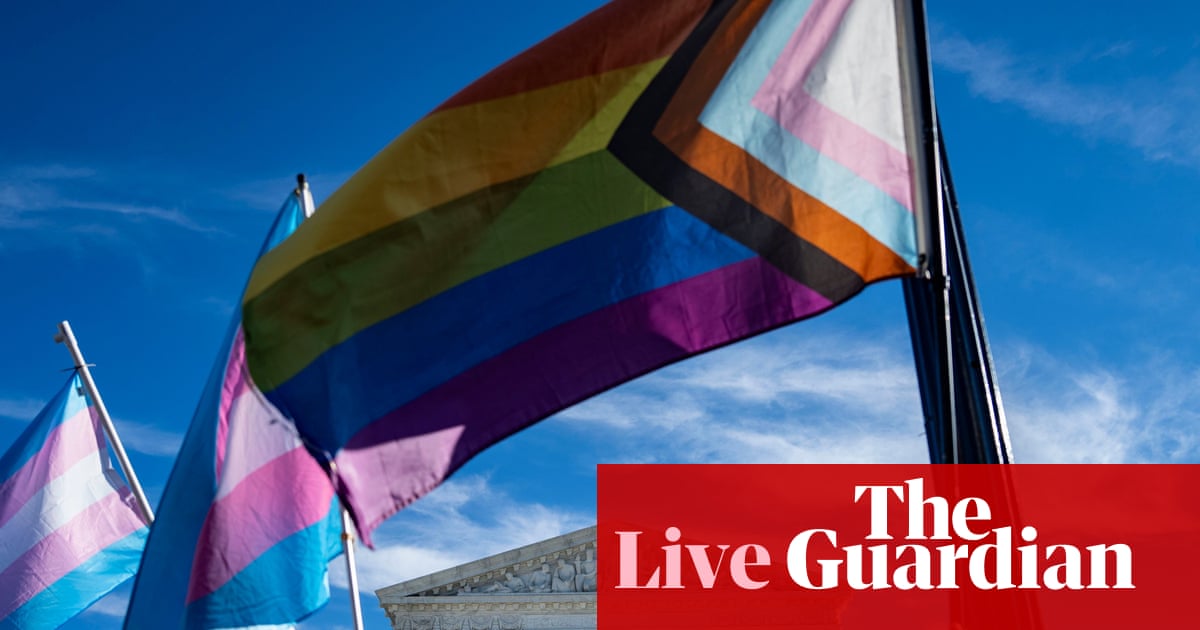
Supreme court appears likely to rule in favor of states that ban transgender athletes in school sports
After more than three hours of arguments, the supreme court’s conservative justices signalled sympathy toward the legality of Idaho and West Virginia state laws banning transgender athletes from participating on female sports teams.
Here is a brief summary of some of key points from the proceedings, per Reuters.
-
Conservative Justice Brett Kavanaugh noted that the federal government, certain states, the NCAA governing body for college sports and the US Olympic Committee “think that allowing transgender women and girls to participate will undermine or reverse that amazing success, and will create unfairness”. “Obviously, one of the great successes in America over the last 50 years has been the growth of women’s and girls’ sports. And it’s inspiring,” he said.
-
Alan Hurst, Idaho’s solicitor general arguing for the state, also touched on that issue. “If women don’t have their own competitions, they won’t be able to compete,” Hurst said. “Idaho’s law classifies on the basis of sex, because sex is what matters in sports,” Hurst told the justices. “It correlates strongly with countless athletic advantages, like size, muscle mass, bone mass and heart and lung capacity.”
-
But “gender identity does not matter in sports,” Hurst argued, “and that’s why Idaho’s law does not classify on the basis of gender identity. It treats all males equally and all females equally regardless of identity. And its purpose is exactly what the [state] legislature said – preserving women’s equal opportunity.”
-
The challengers argued that these measures discriminate based on an individual’s sex or status as a transgender person in violation of the constitution’s 14th amendment guarantee of equal protection under the law, as well as the Title IX civil rights statute that bars discrimination in education “on the basis of sex”.
-
“It is undisputed that states may separate their sports teams based on sex in light of the real biological differences between males and females. States may equally apply that valid sex-based rule to biological males who self-identify as female,”
said the Trump administration’s lawyer Hashim Mooppan, arguing in support of the states. -
“Denying a special accommodation to trans-identifying individuals does not discriminate on the basis of sex or gender identity or deny equal protection. All of that remains true even assuming a man could take drugs that eliminate his sex-based physiological advantages,” Mooppan said.
-
West Virginia solicitor general Michael Williams, arguing for the state, called the challenge a “backdoor attack on Title IX”. The challenger, Williams said, “says that West Virginia schools can no longer designate teams by looking to biological sex. Instead, schools must place students on sports teams based on their self-identified gender. But that idea turns Title IX – a law Congress passed to protect educational opportunities for girls – into a law that actually denies those opportunities for girls. The court should not embrace that backwards logic.”
-
The plaintiffs maintained that the use of puberty blockers or gender-affirming hormones by transgender students should matter regarding whether states can lawfully apply these bans because these medications may prevent or eliminate sex-based physical advantages. Defenders of the bans said such advantages remain despite medical treatments. “In short, male athletes who take performance-altering drugs are not similarly situated to female athletes, and states need not treat them the same,” Mooppan said.
-
Kathleen Hartnett, representing the plaintiff who challenged Idaho’s law, said her client mitigated the competitive advantage through the use of testosterone suppressants and oestrogen, eliminating the ban’s justification.
Decisions are expected by early summer.
Key events
We’re closing out our live coverage of the supreme court hearing. You can read our latest full report here:

Robert Tait
If the court rules trans people are not covered by Title IX, it could boost policies meant to ban trans students’ bathroom access and ability to use chosen pronouns and names, and leave LGBTQ+ youth with fewer protections against harassment, bullying and discrimination.
Pepper-Jackson said in a statement last week that she plays sports to “make friends, have fun, and challenge myself through practice and teamwork”, adding: “All I’ve ever wanted was the same opportunities as my peers. But in 2021, politicians in my state passed a law banning me – the only transgender student athlete in the entire state – from playing as who I really am. This is unfair to me and every transgender kid who just wants the freedom to be themselves.”
After oral arguments on Tuesday, the supreme court received an emergency application in another legal battle involving transgender students.
The New York Times reports that the emergency application related to a California law from 2024 that bars schools from asking teachers to notify parents if their children change their names or pronouns in school.
In December, a federal district judge said parents did have a right to be notified. Federal appeals court judges then paused that ruling. Lawyers for the plaintiffs have now asked supreme court justices to weigh in, potentially lining up another case with wide-ranging implications for LGBTQ+ rights.
Lex McMenamin
Attorneys from both sides are now exiting the court. The left side of the protesters are chanting “Becky” for the teen plaintiff represented by national LGBTQ organizations including the ACLU, Becky Pepper-Jackson.
The legal team representing West Virginia’s law is speaking to press while the anti-trans speakers continue to the right.
Supreme court appears likely to rule in favor of states that ban transgender athletes in school sports
After more than three hours of arguments, the supreme court’s conservative justices signalled sympathy toward the legality of Idaho and West Virginia state laws banning transgender athletes from participating on female sports teams.
Here is a brief summary of some of key points from the proceedings, per Reuters.
-
Conservative Justice Brett Kavanaugh noted that the federal government, certain states, the NCAA governing body for college sports and the US Olympic Committee “think that allowing transgender women and girls to participate will undermine or reverse that amazing success, and will create unfairness”. “Obviously, one of the great successes in America over the last 50 years has been the growth of women’s and girls’ sports. And it’s inspiring,” he said.
-
Alan Hurst, Idaho’s solicitor general arguing for the state, also touched on that issue. “If women don’t have their own competitions, they won’t be able to compete,” Hurst said. “Idaho’s law classifies on the basis of sex, because sex is what matters in sports,” Hurst told the justices. “It correlates strongly with countless athletic advantages, like size, muscle mass, bone mass and heart and lung capacity.”
-
But “gender identity does not matter in sports,” Hurst argued, “and that’s why Idaho’s law does not classify on the basis of gender identity. It treats all males equally and all females equally regardless of identity. And its purpose is exactly what the [state] legislature said – preserving women’s equal opportunity.”
-
The challengers argued that these measures discriminate based on an individual’s sex or status as a transgender person in violation of the constitution’s 14th amendment guarantee of equal protection under the law, as well as the Title IX civil rights statute that bars discrimination in education “on the basis of sex”.
-
“It is undisputed that states may separate their sports teams based on sex in light of the real biological differences between males and females. States may equally apply that valid sex-based rule to biological males who self-identify as female,”
said the Trump administration’s lawyer Hashim Mooppan, arguing in support of the states. -
“Denying a special accommodation to trans-identifying individuals does not discriminate on the basis of sex or gender identity or deny equal protection. All of that remains true even assuming a man could take drugs that eliminate his sex-based physiological advantages,” Mooppan said.
-
West Virginia solicitor general Michael Williams, arguing for the state, called the challenge a “backdoor attack on Title IX”. The challenger, Williams said, “says that West Virginia schools can no longer designate teams by looking to biological sex. Instead, schools must place students on sports teams based on their self-identified gender. But that idea turns Title IX – a law Congress passed to protect educational opportunities for girls – into a law that actually denies those opportunities for girls. The court should not embrace that backwards logic.”
-
The plaintiffs maintained that the use of puberty blockers or gender-affirming hormones by transgender students should matter regarding whether states can lawfully apply these bans because these medications may prevent or eliminate sex-based physical advantages. Defenders of the bans said such advantages remain despite medical treatments. “In short, male athletes who take performance-altering drugs are not similarly situated to female athletes, and states need not treat them the same,” Mooppan said.
-
Kathleen Hartnett, representing the plaintiff who challenged Idaho’s law, said her client mitigated the competitive advantage through the use of testosterone suppressants and oestrogen, eliminating the ban’s justification.
Decisions are expected by early summer.
And that’s it, arguments have ended.
Lex McMenamin
Oral arguments are running later than anticipated, and both groups of demonstrators outside the supreme court are attempting to maintain the momentum. The tension is higher than previous recent protests around trans rights outside the court, such as Skrmetti.
Right wing content creators are bird-dogging trans advocates speaking to press, and anti-trans protesters are moving into the trans rights crowd.
Amy Coney Barrett returns to a theme raised several times by the court’s conservatives: If transgender girls with no competitive advantage can join girls’ sports in West Virginia, would boys be able to join girls’ teams if they also have a similar skill level?
Block replied, no. Boys and girls have separate teams to give girls athletic opportunities without having to face other players who have the physical advantages that come with male puberty; not based on how good they are at sports.
Pepper-Jackson, he went on, did not go through male puberty and so is “completely in the position she could have been if her sex assigned at birth was female”.
Indeed, given that she had been through female puberty, Block argued that Pepper-Jackson has no physiological / competitive advantage.
The purpose of sex separation is to control for the sex-based differential that comes through puberty. By virtue of her medical care, BPJ has controlled for those sex-based advantages.
Joshua Block, an attorney for the American Civil Liberties Union, is now arguing on behalf of Becky Pepper-Jackson.
Chief Justice John Roberts questioned whether the court’s landmark 2020 finding that federal law protects transgender people from workplace discrimination also applies to women’s sports.
Roberts sided with the majority in that decision, but indicated that the reasoning might not apply in this case.
The question here is whether or not a sex-based classification is necessarily a transgender classification.
Trans youth athletes speak out: ‘Sports is my everything’
In the lead up to today’s oral arguments, we spoke with trans youth athletes and their families about the role of sports in their lives and the toll of exclusionary policies.
Here are clips from interviews with three students:
More from those conversations here:
Hashim Mooppan is now arguing for the Trump administration for the second time today, this time in support of West Virginia’s state law.
In his opening statement, Williams said:
The law is indifferent to gender identity because sports are indifferent to gender identity.
He also argued that transgender girls have inherent biological advantages, though Pepper-Jackson’s lawyers have said that she does not because of puberty-blocking medications.
The 15-year-old is the only known transgender student-athlete seeking to compete in the state.
Lex McMenamin
Outside the supreme court, the crowd on both sides has slowly started dissipating, particularly the anti-trans side, though speakers continue.
On the anti-trans side to the right, speakers can be heard arguing that gender is biologically constructed; much of the rhetoric is focused on calling trans women “men” and claiming they are “male athletes”.
To the left, a group of West Virginians who traveled by bus to DC are telling the crowd they stand with Becky Pepper-Jackson: “[US senator] Jim Justice doesn’t speak for West Virginia.”
In his opening remarks, West Virginia’s solicitor general Michael Williams said that the state legislature “reasonably and rationally defined sex based on biology and acknowledged the physical differences biology creates”.
He argued that this “preserves the enduring structure on which girls’ sports depends”.
Arguments in Idaho case end as court moves on to West Virginia challenge
The arguments in the first case have now ended, justices are now hearing arguments in a challenge to a West Virginia law by high school student Becky Pepper-Jackson (she was in middle school when the case began).
And conservative justice Amy Coney Barrett asked Harnett how she can argue that there is discrimination based on transgender status when anyone, including transgender boys, can play on boys’ sports teams under the Idaho law, meaning only trans girls are affected.
Hartnett said the court has not required the entire protected class to be excluded in other similar cases, and reiterated that her case focuses on a specific subgroup targeted by the law.
