

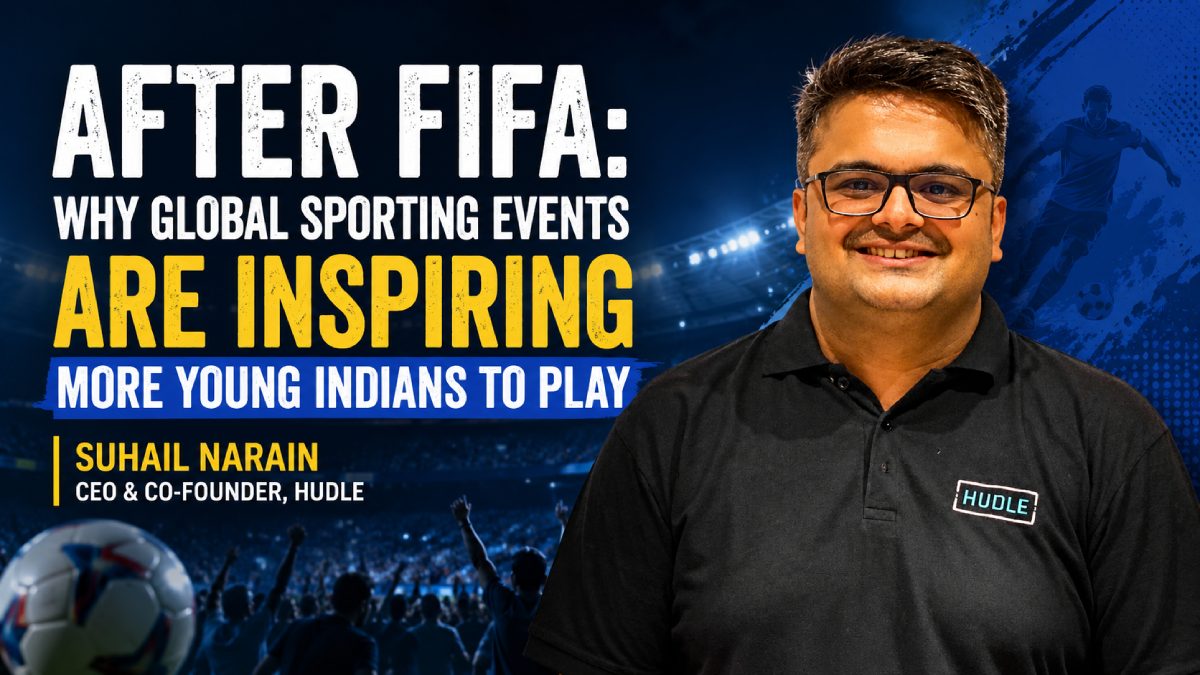
Every four years, the FIFA World Cup captures the imagination of millions of football fans across India. That scale is built entirely on appreciation for the game rather than any stake in the outcome.
It marks a distinct category of fandom, one now proving to be the strongest driver behind young Indians converting from spectators into players.
“Watching” Is Turning Into Participation
This marks a departure from how sport has traditionally been consumed domestically. Cricket fandom in India is inseparable from national identity; every innings is read against collective mood and pride.
Olympic viewership follows a compressed version of the same pattern, with coverage built almost entirely around medal counts. Global football breaks from this. It offers Indian audiences a relationship with sport built on craft and rivalry alone, with no personal or national stake attached to the result.
That difference in emotional structure, low-stakes versus high-stakes, is not incidental. It changes what audiences take away from the experience, and increasingly, what they choose to do next. The behavioural shift follows directly from this.
Cricket has trained a generation to treat playing as a competitive, selection-driven pursuit: something worth doing only if you are good enough to matter within a hierarchy.
Global football, tennis and newer formats like padel are training a different instinct: playing as a way to access the same appreciation experienced while watching, independent of any competitive outcome.
This is a structurally different motivation for participation and a more durable one, because it does not depend on talent or a pathway to sustain itself. It only depends on access to a game.
When Sport Becomes a Legitimate Pursuit
A second, quieter shift is happening around legitimacy. For decades, a sport’s worth in an Indian household hinged on whether it offered a visible, respectable career pathway, a bar football, tennis and athletics rarely cleared for most families.
Global events are changing that by making the economics of these sports visible: seeing the scale of endorsement deals, transfer fees and media rights attached to football, F1 or global badminton circuits quietly recalibrates what parents consider legitimate.
Tennis shows this clearly within racquet sports, where Wimbledon’s stature has long made the game feel aspirational, a credibility now extending to padel as households discover it.
Hudle’s India Padel Report 2026 reflects this shift in numbers, with games played per padel player rising 73 percent over the past year, a sign families are treating the sport as a habit rather than a passing interest. The permission structure inside Indian homes is shifting before the infrastructure is.
The third shift is intellectual rather than emotional. Fantasy leagues, prediction platforms and statistics-heavy sports content have made Indian audiences fluent in the mechanics of games they never grew up playing. People who could not have explained an offside rule a decade ago now debate pressing systems and expected-goals models with the fluency of long-time fans.
That literacy creates its own pull toward participation, because understanding a sport intellectually creates discomfort with only ever experiencing it as a spectator. Watching becomes an incomplete relationship with something you now understand well enough to want to test physically.
India’s New Sporting Habit
This shift is not about football or any single tournament. Global events serve as recurring proof points for something already underway: sport in India is decoupling from nationalism and career anxiety, becoming a personal, community-driven habit built as much on belonging as on performance. That explains the participation numbers emerging in newer formats better than facilities or visibility alone.
The opportunity ahead is to build this new relationship with sport. A generation is arriving with the desire to play, not only to compete; to participate, not only to perform.
For India’s sporting ecosystem, that means making sport easier to discover, access, and return to across cities, formats and skill levels. Talent pathways will always matter, but they cannot be the only measure of sporting progress. The bigger opportunity is to create a culture where recreational play becomes part of everyday life.
If India can respond to that shift, the next decade of sport will not be shaped only by medals, leagues or elite athletes. It will also be shaped by millions of young people choosing to step onto a court, a turf or a field because sport finally feels within reach.
Story first published: Thursday, August 6, 2026, 17:42 [IST]
