

In the previous extra edition, we looked at the path from two-year colleges to four-year colleges, focusing on the NJCAA.
The evaluation at the time of high school graduation is not the final evaluation.
If you build up your credits, physical condition, game footage, and athletic achievements at a two-year college, there is a possibility of being evaluated again by a different university.
So, is the NCAA the only option for four-year universities beyond that? The answer is no.
In the United States, there is the NAIA, which governs four-year college athletics separately from the NCAA.
National Association of Intercollegiate Athletics.
Although not as well-known in Japan as the NCAA, it is neither a subordinate organization of the NCAA nor another name for NCAA Division III. It is another college sports organization with its own member schools, rules, national championships, and scholarship systems.
Understanding the NAIA reveals that US college sports are not just made up of large schools and massive broadcasting rights.
What the NAIA supports is primarily sports at small-scale universities.
There, sports are not just a business for winning games or raising the university’s profile.
They also serve as a management tool for attracting students, retaining them, leading them to degree completion, and ensuring the survival of the university itself.
What is the NAIA?
According to official NAIA information, as of 2026, approximately 250 universities are members, forming 20 conferences. The number of athletes exceeds 89,000, and 31 national championships are held. The total annual financial aid provided to athletes by member schools exceeds $1.3 billion.
The core consists of relatively small four-year universities, including private ones. There are member schools not only in the United States but also in British Columbia, Canada.
The important thing is that the NAIA is not NCAA Division IV.
It is a governing organization separate from the NCAA, and member schools choose the organization that fits their size, educational philosophy, finances, and athletic operations. Some universities move from the NCAA to the NAIA, while others move from the NAIA to the NCAA.
This movement does not necessarily mean promotion or relegation in terms of athletic ability.
Which rules and cost structures fit the school? Which regional universities do they play against? How do they use sports for student recruitment and education?
What universities are choosing is not a ranking of athletic ability, but an operating model that suits them.
How is it different from the NCAA?
Simply dividing the NAIA and NCAA into ‘large organizations’ and ‘small organizations’ misses the essence.
The difference lies not only in scale but in how the systems are structured.
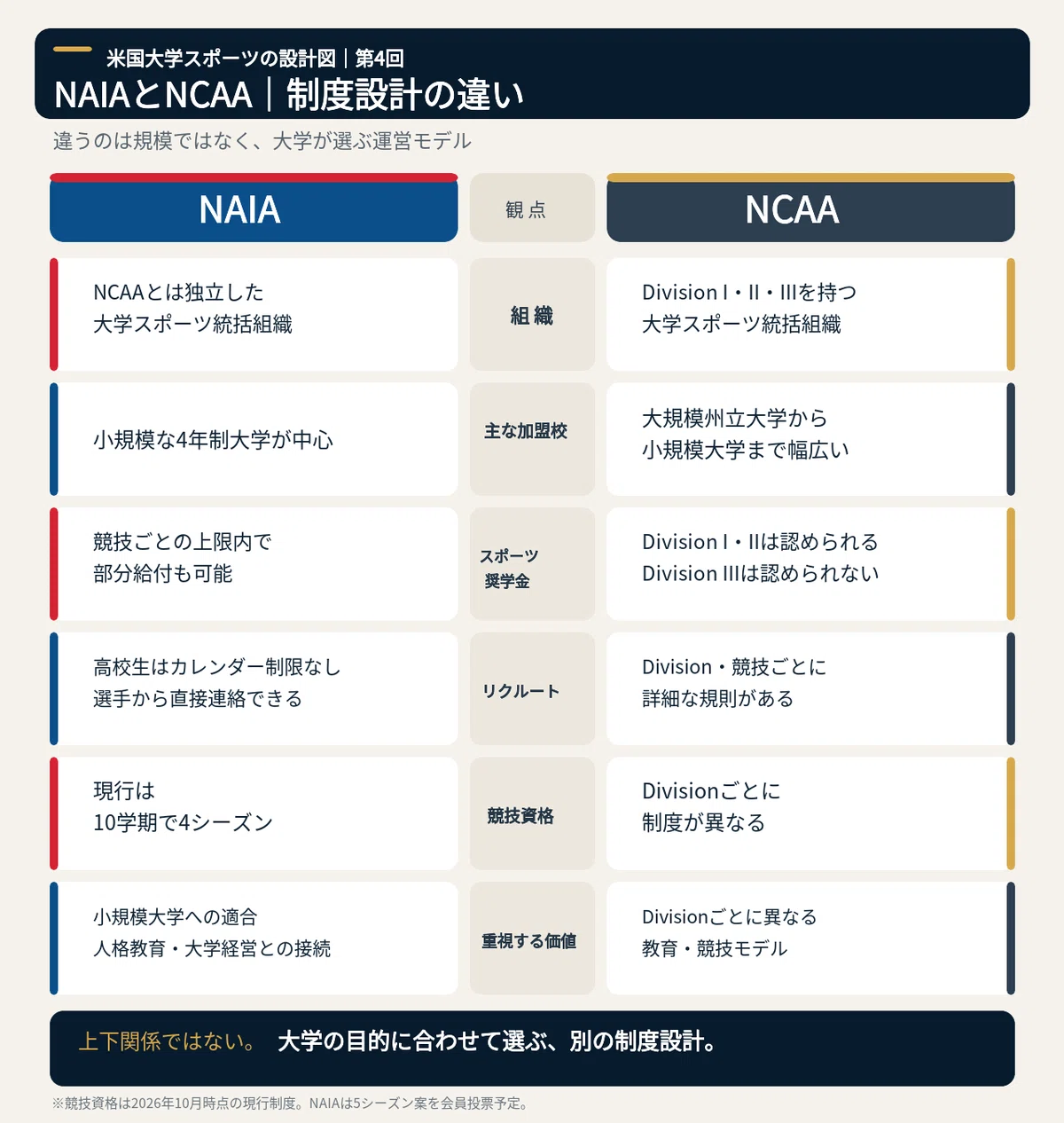
Of course, this does not mean that NAIA rules are completely free.
All first-time participating athletes must register with the PlayNAIA Eligibility Center and undergo verification of their academic and athletic history. Transfer students are also screened for their grades and athletic participation history at the universities they previously attended.
However, the timing for contact between athletes and coaches is more flexible than in the NCAA. The NAIA’s guide for high school students clearly states that there are no restrictions on the recruiting calendar for high school students, and that athletes can contact coaches directly.
Even without being part of a large-scale scouting network, you can send your footage, grades, and desired major yourself to create a connection with a university.
The NAIA is not a market that just waits for athletes. It is a market where athletes themselves can go and look for a university that suits them.
NAIA scholarships are made up of a “combination”
Athletic scholarships are permitted in the NAIA.
However, not everyone receives a full scholarship.
Under NAIA Financial Aid rules, each university determines the amount of aid for individual athletes. This can cover tuition, mandatory fees, books and supplies required for courses, and room and board.
On the other hand, there is a cap on total aid for the entire team per sport.
For example, in baseball, the limit is equivalent to 12 full scholarships. It is not necessary to give a full scholarship to only 12 people. You can divide it up—a full scholarship for one person, half for 10 people, a quarter for 24 people—as long as the total is within the limit.
This is a concept known as “equivalency.”
Furthermore, academic scholarships for students who meet certain academic standards can sometimes be excluded from the per-sport aid calculation. By combining athletic scholarships, merit-based scholarships, need-based aid, and external scholarships, the final out-of-pocket cost is determined.
Therefore, what athletes and their families should check is not just “whether there is an athletic scholarship.”
How much is the tuition? How much are room and board? Can it be combined with academic scholarships? Is it renewed every year? Do the conditions change due to injury or quitting the team? What will the total cost be until graduation?
It is necessary to look at the actual cost until graduation, not just the title of “scholarship athlete” or the offered amount.
A path after the NJCAA
The NAIA is also an important path for athletes transferring from two-year colleges such as the NJCAA.
Athletes who have earned credits and achievements at a two-year college do not necessarily move on to NCAA Division I. When comparing playing opportunities, majors, scholarships, university size, and team compatibility, the NAIA may be more suitable.
The NAIA’s guide for transfer students assumes transfers from both two-year and four-year colleges as part of its system. The Eligibility Center verifies athletic participation history both inside and outside of universities, transcripts from all colleges, and even high school information if necessary.
Transferring does not mean your previous athletic history disappears.
Under the current system, athletes can compete for four seasons in the same sport within the first 10 semesters of enrollment at a university. They are also required to take at least 12 credits per semester and make normal progress toward earning a degree.
In other words, the NAIA is not a place that allows for an unconditional fresh start.
It is a place to continue at another university while carrying over the athletic eligibility used and credits earned up to that point.
In 2026, the NAIA is also considering a “five-season” rule.
Here, I would like to touch upon a major institutional change currently underway.
As of October 2026, the NAIA is preparing to put a proposal to a formal member vote to change athletic eligibility from “four seasons in 10 semesters” to “five seasons in 10 semesters.”
According to the NAIA’s official explanation, the voting date is November 4, 2026. If passed, the proposal would maintain the 10-semester enrollment limit while allowing for five seasons of athletic participation within that timeframe.
This is similar to, yet distinct from, the NCAA Division I’s new system, which starts a five-year clock based on age and initial full-time enrollment.
The NAIA proposal keeps the traditional structure based on the number of semesters while adding one more season of eligibility.
The background to this is the recruiting competition with the NCAA. If only the NAIA remains at four seasons, it could be seen as a disadvantage for student-athletes. On the other hand, there are concerns that it could extend the duration of enrollment and increase the burden on students for the sake of athletics.
Increasing athletic opportunities versus ensuring degree completion in the shortest possible time. How to balance these two?
This debate shows that the NAIA is not simply following the NCAA’s lead, but is trying to adjust competitive conditions while protecting its own educational model.
Note: This section is as of October 11, 2026. As the vote has not yet taken place, the current rule remains “four seasons in 10 semesters.”
For small colleges, sports are student recruitment.
This may be the most important point in understanding the NAIA.
The NAIA does not view sports as separate from university management.
Small US colleges face challenges such as a declining birthrate, shifts in the college-bound population, tuition dependency, and rising operating costs. Unlike state universities with tens of thousands of students, for colleges with hundreds or a few thousand students, an increase or decrease of a few dozen enrollments directly impacts management.
That is where sports become an entry point for student recruitment.
If a college establishes teams for American football, soccer, track and field, wrestling, volleyball, competitive cheer, or bowling, it can create a reason for students who want to continue those sports to enroll. If they have not only varsity but also JV teams, they can accept even more students.
Of course, if the college provides scholarships to athletes, its revenue decreases. There are also costs for coaches, facilities, travel, and safety management.
Even so, if the result of subtracting scholarships and athletic operating costs from the tuition and room and board paid by athletes leaves a positive effect on the university as a whole, sports become an investment rather than just an expense.
The NAIA uses this concept as its own analytical foundation called Return on Athletics.
It does not just look at winning percentages. How many students were recruited? How many were retained at the university? How much was spent per athlete? What is the tuition revenue after subtracting scholarships? Does it lead to graduation?
The NAIA attempts to measure the impact of sports on student recruitment, retention, and finance by comparing student, athletic, and financial data from member schools. Its official website states that the average NAIA athletic department generates a net return of approximately $4 million. However, this is a figure based on the NAIA’s own calculations and definitions, and it does not guarantee the same results for every university.
Even so, there is a clear stance to measure the value of sports not just by whether they won, but by how they supported the university.
Is increasing the roster a success?
The model of using sports for student recruitment also has its dangers.
If you increase the number of athletic departments, the number of enrolled students might increase. However, without sufficient coaches, facilities, medical care, safety management, and academic support, the student-athlete experience will deteriorate.
Even if you create a large roster, if athletes who cannot play in games drop out early, it becomes a loss for both the university and the students. If the tuition discount through scholarships is too large, no revenue will remain even if the number of students increases. If cross-regional travel increases, costs and class absences will also increase.
Therefore, what should really be measured is not the number of recruits.
It is the retention rate after enrollment, credit acquisition, graduation rate, athletic continuation rate, net revenue per athlete, and whether the athletes are satisfied with their university life.
Sports can attract students. However, if you cannot educate the students you have gathered, it cannot be said that you have succeeded as a university sports program.
The value of the NAIA’s management model is not in calling sports a revenue-generating device.
It lies in trying to look at revenue and educational outcomes on the same table.
Making ‘Character Education’ an Institution
Another feature that the NAIA promotes is ‘Champions of Character’.
The core values are five: integrity, respect, responsibility, sportsmanship, and servant leadership.
This is not just a public relations slogan. It is incorporated into coach training, athlete education, community activities, awards, and member school evaluations. The NAIA explains that its character education coach training is the only mandatory program in college sports.
It does not compete with NCAA Division I through massive broadcasting rights or national brand power.
It sells as value its small-scale campus, the closeness between athletes and faculty, its relationship with the local community, and an athletic experience centered on education.
The NAIA does not hide its small size as a weakness, but turns it into a part of its product.
What Scottie Pippen and Dennis Rodman showed
There are also athletes in the NAIA who later advanced to the top of the world.
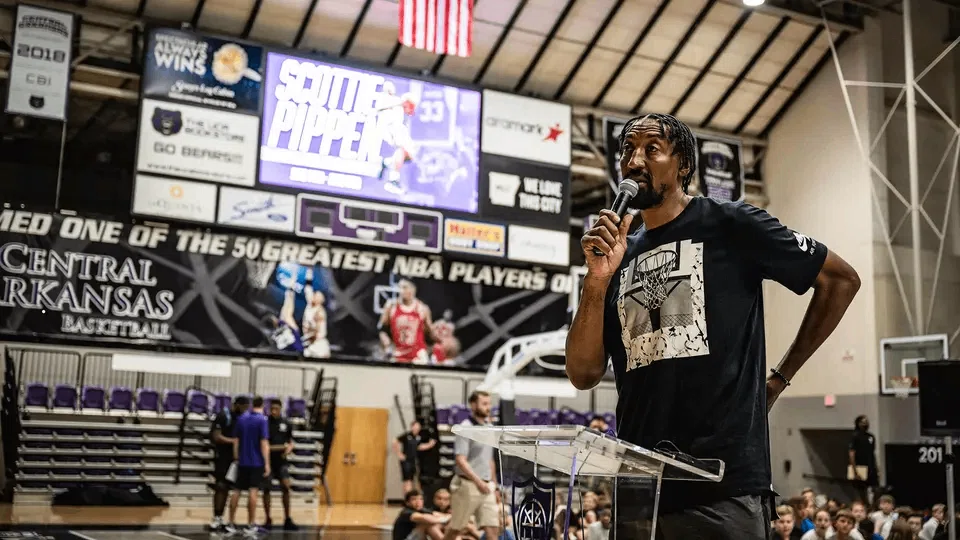
Scottie Pippen played at the University of Central Arkansas and was selected as an NAIA All-American in 1986 and 1987. He started as a team manager upon enrollment and emerged as an athlete as his body grew. He later experienced six NBA championships with the Chicago Bulls.
Dennis Rodman went to Southeastern Oklahoma State University, which was a member of the NAIA at the time, after attending Cooke County Junior College. He was named an NAIA All-American three times and became the NAIA rebounding leader during his junior and senior years. He later won five NBA championships and was inducted into the Basketball Hall of Fame.

The existence of these two does not mean that the overall competitive level of the NAIA is the same as the NBA.
What is important is that players who were outside the evaluation network of major universities had a place in four-year colleges to grow, play in games, and earn their next evaluation.
Sometimes, playing opportunities and environmental fit help players develop more than the size of a brand.
This is also connected to the mechanism seen in the NJCAA section.
US college sports offer not only paths for players who were in the spotlight from the beginning, but also multiple paths for changing evaluations after entering college.
What Japan can learn is not ‘creating a separate league’
When using the NAIA as a reference in Japan, it is not a matter of simply creating a national organization separate from the NCAA.
What should be learned is the ability to choose a competitive model that fits the size and purpose of the university.
Not every university needs to aim for national championships, large-scale facilities, or professional-level entertainment. The necessary form of sports differs for universities that prioritize student recruitment, regional cooperation, education, or competitive performance.
And if you use sports for student recruitment, you should not judge the results solely by the number of recruits.
How much revenue remained after deducting scholarships? Did the athletes continue their studies without dropping out? Did they earn credits and graduate? Were the coaches and facilities commensurate with the number of students? Did it lead to a career path after their athletic career ended?
Integrating college sports into management does not mean turning athletes into products for attracting crowds.
It means aligning the reasons why athletes choose a university with the reasons why the university accepts those athletes within the framework of education.
The meaning of having another market
The NAIA is not a catch-all for universities and players who could not get into the NCAA. It is an independent college sports market that combines rules, scholarships, recruiting, championships, educational philosophies, and management indicators suited to small-scale universities.
In that market, sports are not advertising towers outside the university.
They are placed within a system that welcomes students, helps them settle into the university, fosters their growth, and sends them off to graduation.
If you only look at the NCAA, US college sports appear to be a world of broadcasting rights, massive stadiums, and conference realignment.
However, outside of that, there is a market where small colleges use sports to create connections with students and attempt to balance education with management.
The strength of US college sports lies not only in the size of its pinnacle. It lies in the ability to choose different entry points and different operating models to suit the circumstances of the universities and the athletes.
The NAIA is ‘another market’ outside the NCAA, and it serves as another blueprint for small colleges to balance education and management.
